Medical claims analytics: denial rate and days in A/R
- Denial rate, percent of claims submitted
- 7
- Computed on this page from the inputs below
- Clean-claim rate, percent paid on first submission
- 86
- Computed on this page from the inputs below
- Net collection rate, percent of collectable charges collected
- 90
- Computed on this page from the inputs below
- Gross collection rate, percent of charges collected
- 57
- Computed on this page from the inputs below
Every figure on a worksheet comes from the inputs you enter and the method stated beside it: your minutes, your charges, your EOB amounts and your month's counts. Where a guide names a published rule, the document is cited with a path to the clause, and the figure is licensed in this repository's claims ledger before it appears on a page.
Email me this result
We will send you these figures and a link back to them. One email, nothing else unless you tick the box.
The figures start from a worked example (7), one visit or one claim from a typical small practice. Change any input and the answer recomputes as you type.
Download the Medical claims analytics: denial rate and days in A/R worked example (CSV)
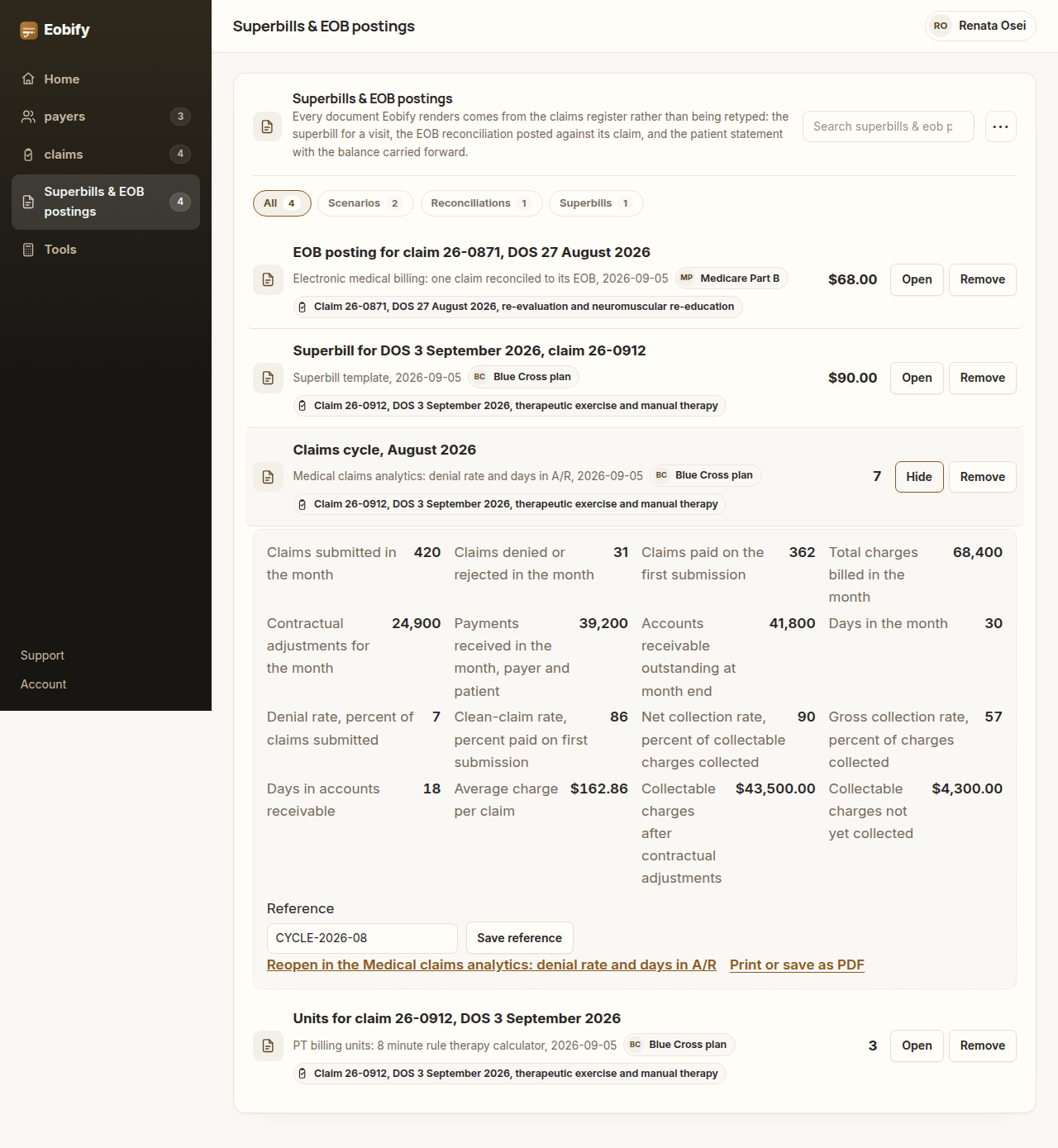
Medical claims analytics for a small practice is six figures from one month's register: the denial rate, the clean-claim rate, the net and gross collection rates, days in accounts receivable and the average charge per claim. This worksheet takes the month's claims submitted, denied and paid on first submission, the charges billed, the contractual adjustments from the EOBs, the payments received, the outstanding balance at month end and the days in the month, and returns those figures with the method beside each one. No benchmark of ours is applied: the worksheet says what your month did, and the guides on this site say what a biller does when a figure moves.
Where the constants in this tool come from
Medical claims analytics: denial rate and days in A/R: what billers ask
Which claims analytics figure should a small practice watch first?
The denial rate, because it is the one the practice can change fastest: each denial has a reason code, and the codes cluster. The clean-claim rate is its mirror image, and days in A/R is what the two do to cash over a quarter.
What is the difference between net and gross collection rate?
Gross divides payments by charges as billed. Net divides payments by charges less the contractual adjustments, which is the money the practice could actually have collected, and it is the figure that says whether the billing is working rather than whether the fee schedule is generous.
How is days in A/R calculated?
The outstanding balance at month end divided by the average daily charge, which is the month's charges over the days in the month. It says how many days of billing are sitting unpaid; the worksheet rounds it to the whole day.
Eobify Pro
Keeping the claims register instead of the spreadsheet
Upgrading turns a worked claim into a register. The EOB you reconciled on the worksheet is posted against the claim it paid; the denial is recorded with its code and the appeal with its date; the patient balance carries forward to the next statement; and the month's denial rate, clean-claim rate and days in A/R are a report rather than a spreadsheet nobody trusts.
- Save a month's figures and compare them with the next month
- Put two months side by side and see what the denial rate did
- Share a month's figures without our name on them
- Send a patient their statement from inside the register
- Not sold on this hub: a practice collects its copays at the desk, not through us
- Not sold on this hub: the month's figures export to your accountant instead
$49per month, whole team
Start Eobify Pro Free for 14 days. No card needed. PricingThe first 14 days are free and no card is asked for. Add a card during the trial and the first charge is on the day it ends; do not, and your workspace becomes read-only with nothing deleted. Eobify Pro is $49 per month for your whole practice, billed monthly, and renews each month at that price until you cancel. The price and the renewal terms are shown again before checkout.